Holes in dead or alive trees are a good option for nesting by birds .Fewer birds like the woodpeckers and Barbets excavate their own holes in trees for nest building.Most tree hole nesters make use of the already existing holes in large or small trees.Most common hole nesters are Parrots, common Starlings, Hornbills, Owls, Indian rollers and some flycatchers.The nest in tree holes has the define advantage of protection from predators and weathers.Birds do modify the tree holes like lining with soft materials or mud plastering in case of Horn bills. However the disadvantage is that due to warm and humid conditions inside the holes there is more chances of avian pests and nest parasites build up.It is a wonder that The Great Indian Hornbill nearly a meter long in size likes to nest at 20-45 meters up the tree .This means it can only nest in trees which have a diameter greater than 1-2 meters at that height. As the large trees are fast decreasing in the forests, the existence of the Great Hornbill is now a concern.
Showing posts with label Biology. Show all posts
Wednesday, October 31, 2012
Hole Nest in Trees
Labels:
Biology,
bird,
Bird nest,
birdwatching,
Great Hornbill,
Hornbill,
nature,
nest,
nesting,
nesting behaviour,
Owl,
Tree,
wildlife,
Woodpecker
Saturday, June 25, 2011
Hanging Nest


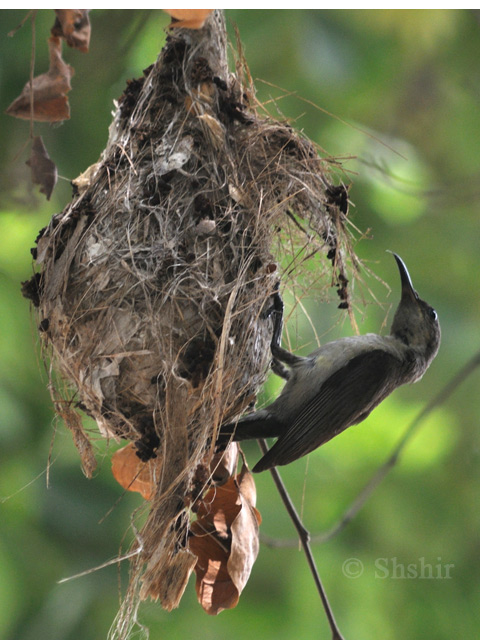
Among all nests build by birds , the hanging nests are the most complex nest bulding , an admirable of bird architecture. In indian the hanging nests found are that of Baya weaver and sunbirds. It require great skill by a bird to build such type of nest.The main purpose of such types of nests are protection from predators and adverse climate. These nests generally hung from the tip of a branch or leaf, or suspended between twigs. They are globular or retort-shaped with a single entrance hole. A completed baya nest looks like an upside down flask with a downward tube like pointing entrance .The swollen portion of the nest is the main nesting area or egg chamber.The sunbird nest is build with cobwebs and caterpillar excreta hanging from a tip of a branch or twig.
Labels:
Biology,
bird,
Bird nest,
hanging nests,
nature,
nest,
photography,
Recreation,
wildlife,
Zoology
Subscribe to:
Posts (Atom)