Showing posts with label bird. Show all posts

Saturday, September 6, 2014

Nesting Behavior of Oriental Pratincole

                                         Fig: Oriental Pratincole chick just after hatching
                                     
Nesting season of Oriental Pratincole is mostly peak summer i.e from April to June The nest is a simple scrap on the ground or  in short grasses on river and reservoir edges. They nests in colony and   also with other species like little terns and small pratincoles.The female lays about 3 to 4 greenish grey densely spotted eggs.Both the parent incubate the eggs for about 18 days.The chicks leave the nest soon after hatching and hide in grasses or stone.Feeding of chicks can hardly be seen as they are under hide.The above photograph is taken at Mahanadi Reservoir of Odisha, India.

Thursday, March 14, 2013

Oriental Pratincole

Common name : Oriental Pratincole, large Indian Pratincole
Scientific Name: Glareola maldivarum


The Oriental Pratincole is a beautiful looking  tern-like shorebird with long, pointed wings  and a forked tail.It is a medium-sized bird measuring 25 cm and weighs approximately 75 g. The sexes are alike, with seasonal variation, and juveniles are easily identifed.During breeding season adults have a dark olive-brown crown and nape, paler olive buff on the neck, dark olive-brown back and upper rump The ear coverts are pale creamy buff, and are separated from the chin and throat by a black  line which runs down from below the eye to encircle the throat and separate it from the upper breast,  the underpart is white.The bill is black with a red gape and base of  lower mandible, the eyes are dark brown, and the legs and feet are brownish black.
The species is generally gregarious, occurring in small to large flocks.Oriental Pratincoles eat insects, including dragonflies, cicadas, beetles, moths, ants, termites, locusts, grasshoppers,  flies, bees and wasps, they also eat flying insects.The species usually feeds aerially. The above photograph s taken at the Mahanadi Reservoir in Sambalpur, Odisha, India.

Wednesday, October 31, 2012

Hole Nest in Trees


Holes in dead or alive trees are a good option for  nesting by birds .Fewer birds like the woodpeckers and Barbets excavate their own holes in trees for nest building.Most tree hole nesters make use of the already existing holes in large or small trees.Most common hole nesters are Parrots, common Starlings, Hornbills, Owls, Indian rollers and some flycatchers.The nest in tree holes has the define advantage of protection from predators and weathers.Birds do modify the tree holes like lining with soft materials or mud plastering  in case of Horn bills. However the disadvantage is that due to warm and humid conditions inside the holes there is more chances of avian pests and nest parasites build up.It is a wonder that The Great Indian Hornbill nearly a meter long in size  likes to nest at 20-45 meters up the tree .This means it can only  nest in trees which have a diameter greater than 1-2 meters at that height. As the large trees are fast decreasing in the forests, the existence of the Great Hornbill is now a concern.
Enhanced by Zemanta

Wednesday, October 17, 2012

Hole Nest in Ground

Very few birds nest within holes in the ground.Nesting in hole  seems to be a better strategy than nesting in the open.We survey around 100,000 eggs and found that non-hole nesters averaged 48% rearing success while hole nesters averaged 74%.The main reasons seems to be eggs within holes in the ground are better protected against adverse environmental conditions and from predators.The hole nests can be  open onto a cliff edge or a vertical edge of a river bank,Road cuttings and those holes in relatively flat ground.Some birds dig the holes themselves and some uses the already existing holes.Birds making this types of nest are green bee eater and all king fishers.Green bee eaters make almost 1 meter hole in flat ground as well as edges to lay their eggs.

Sunday, November 13, 2011

Mud Nest


Birds are excellent builders and is natural that they construct their nest using mud as a primary resource. Birds build their nest entirely out of mud or mix in other materials like grass, feathers etc. The most common birds that use mud to make a nest are members of the swallow family. Swallows and Martins all over the world build their hemispherical or retort shaped nests on the edges of cliffs, under the eaves of houses and under the modern bridges. The mud is collected in small pellets and moistened with saliva before being applied to the wall or existing nest.The nests are lined with grass and fetahers to make it comfortable and durable. These nests are generally found in colonies.

Enhanced by Zemanta

Thursday, September 15, 2011

Black Naped Monarch Flycatcher Feeding


This is the video of a Black naped Monarch Flycatcher feeding it's chick.This Nest is located on a mango tree near Hirakud Reservoir.

Saturday, June 25, 2011

Hanging Nest


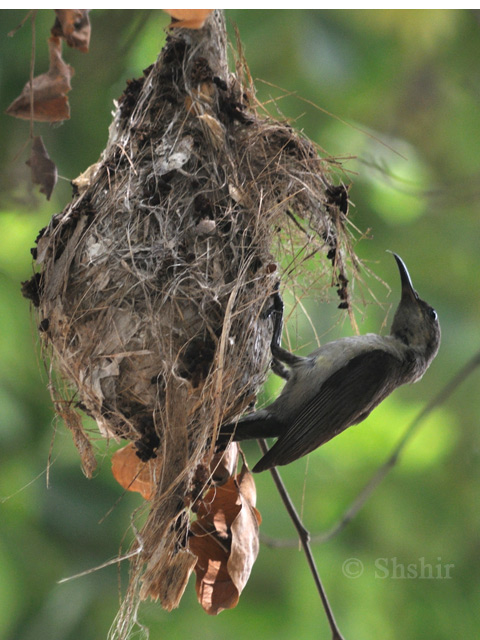
Among all nests build by birds , the hanging nests are the most complex nest bulding , an admirable of bird architecture. In indian the hanging nests found are that of Baya weaver and sunbirds. It require great skill by a bird to build such type of nest.The main purpose of such types of nests are protection from predators and adverse climate. These nests generally hung from the tip of a branch or leaf, or suspended between twigs. They are globular or retort-shaped with a single entrance hole. A completed baya nest looks like an upside down flask with a downward tube like pointing entrance .The swollen portion of the nest is the main nesting area or egg chamber.The sunbird nest is build with cobwebs and caterpillar excreta hanging from a tip of a branch or twig.
Enhanced by Zemanta

Wednesday, October 6, 2010

Nesting Behaviour of Birds: No Nest


The most simple form of nest is no nest at all.Many birds donot build any nest.They either lay eggs directly on the bare ground or rock surface. Some make simple scrap on the ground to lay eggs. It is observed that birds who leaves the nest soon after hatching, generally build this type of nest or more accurately they don't need complex nest at all.Nightjars lay their two eggs directly onto the ground.Birds like Plovers, Pratincoles, Lapwings, Little tern make simple scrap to lay eggs. As the eggs are on open surface they generally camoufladge with their surrounding and there by protected from predators. The picture above is a Little ringed Plover Nest with egg on open ground near a river bank.
Enhanced by Zemanta

Friday, May 7, 2010

Sunbird, The Nesting


Nesting Season of Sunbird varies from February to June.Both the Purple and purple-rumped Sunbird has similar nesting behavior.I have discussed in detail how they build their nest in my post " Sunbird, The nest". The female generally lays 2 to 3 eggs of grayish color with brown spots.The female incubates the egg for a period of about two weeks.The young birds are fed by both the parents.The chicks feed almost 3 times more than their body weight.It is my personal observation that both the parent visit the nest almost 40 times in an hour to feed the chicks. Fledging period is almost 12 days.It is a great pleasure to watch the chicks coming out of the nest and jumping from branch to branch and the parents following them.

Reblog this post [with Zemanta]

Thursday, April 8, 2010

Purple Sunbird

Purple Sunbird( (Nectarinia asiatica) in Kolka...Image via Wikipedia


Purple Sunbird
Species : Nectarinia asiatica
Family : Nectarinidae
Size : Smaller than sparrow

This is another species of Sunbird commonly found in Asiatic region.The only difference here is the color of the male. The breeding male is metallic black with a smooth shiny surface which ranges from green to purple . An orange patch is found on the armpit.Female are same are olive above and yellowish below. In both the species i.e purple sunbird and purple rumped sunbird the females look similar.For more information please read my post " The Purple Rumped Sunbird".
Reblog this post [with Zemanta]

Monday, March 1, 2010

Sunbird, The Nest

Fig. The female Sunbird building the Nest
The nest of sunbirds are architectural marvel. It is generally suspended from a branch at a height of around 10ft from ground. It looks like an oval or oblong purse-shaped pouch with a hooded side-entrance.The collection of nest material and nest building are performed by the female alone with the male only accompanying the female.Before building the nest both male and female first select the appropriate branch of a tree.The female hover around it for a inspection and one can easily confused it with a humming bird. The nest materials consists of soft grasses, dry leaves, barks, pieces of paper and cobwebs.Cobwebs are generally used as a glue material. The nest is about 300 to 600 mm long from tail to tip.The diameter is around 50 to 70 mm at the broadest part.The outer layer consists of coarse materials like dried leaves, barks and even paper and polythene pieces.The inner layers consists of finer materials like cotton fibres or silky substances of seeds and flowers.The nest I observed mostly. The interior of the nest contains the egg chamber which is the thickest portion of the nest i.e 30mm thick.The interior gives utmost comfort to the chicks to grow.On a an average a nest is built with in 10 to 15 days.
Reblog this post [with Zemanta]

Wednesday, February 24, 2010

Purple-rumped Sunbird

Fig. This is the female and male purple-rumped sunbird

Purple-rumped Sunbird


Species Nectarinia zeylonica

Family Nectarinidae

Size About 10 cm

Purple-rumped Sunbird is a colorful and very active tiny little bird.This bird is endemic to Indian subcontinent and a common resident breeder in India, Sri Lanka and Bangladesh. Purple-rumped Sunbirds are smaller in size i.e less than 10 cm long.The male and female looks different.The males have a dark metallic maroon upper side with a blue-green crown which glitter on sunlight. Metallic violet patches are also found around throat and only visible at certain angle.The female has a white throat followed by yellowish breast.The upper side is olive or brownish. They have medium-length thin down-curved bills and tubular tongues which are made for nectar feeding. This photograph is taken at Debrigarh wildlife sanctuary , Sambalpur, India.
Reblog this post [with Zemanta]

Sunday, February 7, 2010

Sunbird


Fig. This is a purple rumped sunbird

Sunbirds are colourful, attractive small passerine birds. and readily enter gardens where flowering plants are planted to attract them. The sunbirds and spiderhunters belongs to family Nectariniidae. The family is distributed throughout Africa, southern Asia and northern Australia.The sunbirds have two close relatives, the hummingbirds of the Americas and the honeyeaters of Australia. The resemblances are due to similar nectar-feeding lifestyle.There are more than 100 species of sunbird in 15 genera.Two most common species seen in India are Purple Sunbird (Nectarinia asiatica) and Purple-rumped Sunbird (Nectarinia zeylonica).When one sees them feeding nectar on flight can easily be confused it as Humming bird.However we have no Humming birds here in India.Sunbirds are frequent visitors to gardens where flowering plants are present.They also built their nest in backyard gardens .

Reblog this post [with Zemanta]

Monday, January 25, 2010

Plani Prinia Feeding


The above photographs are showing the Plain Prinia parents feeding the chicks.I managed to locate the nest inside a bush at about 2 ft from ground.Observed it for almost 15 days. By the time the bird get comfortable with my presence. I waited and watched the bird feeding the chicks entire day.Finally got some feeding shots.You can clearly see the bird holding a grasshopper and feeding it to the chicks.The chicks are voracious feeders.They eat almost 3 to 5 times of their body weight.The parents keep the nest clean by clearing the droppings inside the nest.After 12 days of hatching finally the chicks left the nest.This is the beauty of nature and beauty of bird watching.Yhis photograph is taken with a 200 mm lens with Nikon F3 camera.
Reblog this post [with Zemanta]

Sunday, January 10, 2010

Small Minivet


This is one of the fresh photograph of female small Minivet feeding the chicks. I have posted earlier about this bird on my post Fire on the wings.You can see in this picture how the nest is built on the fork of a branch and almost camouflage with the tree.Even the chicks are not easily visible. This is how the bird protects their chicks from predators. I observe this bird for days feeding the chicks high on a tree. Finally got a chance to take some photographs.Enjoy this beauty of nature. In this new year lets unite to save these wonderful birds so that our future generation will able to see them.
Reblog this post [with Zemanta]

Sunday, December 20, 2009

Red-vented Bulbul,The Nesting


The breeding season of Red-vented Bulbul is from March to July.It builds its nest at the fork of a branch of tree or bush generally at a height of around 2-5 m (7-15 ft). Nests are occasionally built inside houses.The nest is cup shaped built with rootlets. Mostly three eggs are found which are pinkish in color blotched with brown.Both the parent incubates the egg for a period of 15-18 days. The chicks remain in nest and are fed for about 10 to 12 days by both the parents.They keep the nest clean by swallowing the fecal material.

This nest in above photograph is built in a Bougainvillea plant in my friend's house just in front of the main gate. I watched it regularly and taken few shots without disturbing the bird.This photograph is taken by my Nikon F801 camera with a 200 mm lens.This is a bright example of man and wildlife thriving side by side.Enjoy the bird watching and know the bird in your back yard.


Reblog this post [with Zemanta]

Friday, December 4, 2009

Red-Vented Bulbul


Common name: Red-vented Bulbul
Species          : Pycnonotus cafer
Family            : Pycnonotidae
Size                : Smaller than a Myna


The Red-vented Bulbul  is a passerine bird  of the bulbul family .The body is a grayish  brown with a scaly pattern above and gray below.The Red-vented Bulbul is easily identified by its  crested glossy black head .  The rump is white while the vent is red i.e  a distinguishing  red patch under  the tail. The black tail is tipped with white. Both male and female look alike.This bird is commonly seen in gardens, scrub jungles and also near human habitation and cultivated lands.It feeds mainly on fruits, petals of flowers, nectar, insects etc. Mostly seen collecting figs to eat from the  trees like peepal and baniyan. The bird can be easily identified from its  whistling sound .It can be easily reared and tamed.In India it is used as a common fighting bird which shouldn't be.After all birds are born to be free.It is nice to observe them in their natural habitat moving freely.

Monday, November 9, 2009

Asian Paradise Fly catcher, The nesting


Nesting Season of Asian Paradise flycatcher is generally June to August i.e the rainy season.It may be due to availability of more flying insects during this period.

The nest is conical in shape and just the size of a tea cup.It is found hanging from a tip of a small and thin branch of a tree generally at a height of 8ft to 15ft from the ground. The nest is woven with fine grasses and fibers.The outer wall of nest is plastered with cob webs and spider egg shells. It is observed that the female alone built the nest.The female generally lays four numbers of pale pink colour eggs with blotches of reddish brown.In some cases three eggs are also found. Incubation takes nearly 18 days and both the parent incubate the eggs alternately.The nestling period is around 10 to 12 days.The chicks are raised by both the parents.

It is quite thrilling to watch the parents feeding the nestlings.I observed it very close to the nest.The photograph is taken by my pretty old Nikon 801 camera with a 200 mm lens.Watching nature so close is a rare experience to share.Enjoy the bird Watching.

Friday, October 2, 2009

Asian Paradise Flycatcher, The Male

The typical adult male "Asian Paradise flycatcher" is about 20cm long.But the long ribbon like tail of almost 30cm is the most significant character of the male.It is amazing to watch the bird with such a long tail flying from tree to tree and hunting flying insects.

Another significant character of the male is that it changes it's color during it's development from subadult to adult male .The subadult male ( first two years of growth ) have chestnut brown color on the back with whitish underpart and metallic blue black head.When it grows to adult male i.e in third year from hatching it changes it's color to shining white except the head.The wings laterally appears to have black stripes.In some cases in the second year of development the male with partly white and partly chestnut brown color tail is also seen.

This is the beauty of nature in true sense.I watch these birds for hours and admire their beauty.All these photographs are shot with my pretty old Nikon F3 camera and a 200 mm lens.

Sunday, September 13, 2009

Asian Paradise Flycatcher


Asian Paradise Fly Catcher
Species :
Terpsiphone paradise
Family : Corvidae
Size : About the size of Bulbul

The Asian Paradise-flycatcher is a noisy bird with a sharp skreek call. It has short legs and sits very upright whilst perched prominently, like a shrike. It is insectivorous, hunting by flycatching .Pairs are seen moving after winged insects in shady grooves and thin jungles near nullahs. Sometimes seen near homestead in rural areas. The birds are seen moving only after the tiny creatures that fly and catch those in flight. The birds as observed are not sedentary and arrive at this locality during March much before the rain every year.

The sub adult male and female look alike except the tail.The bird is usually 20cm long while the male has a 30 long tail which is the unique character.The body of the female is chestnut brown color with grayish underpart.The head and throat are metallic black.The eyes have blue circle.The tail is short and roundish.I will tell about the male in my next post which is very unique as compare to other birds.Now enjoy the beauty of bird watching.