Showing posts with label photography. Show all posts

Thursday, March 14, 2013

Oriental Pratincole

Common name : Oriental Pratincole, large Indian Pratincole
Scientific Name: Glareola maldivarum


The Oriental Pratincole is a beautiful looking  tern-like shorebird with long, pointed wings  and a forked tail.It is a medium-sized bird measuring 25 cm and weighs approximately 75 g. The sexes are alike, with seasonal variation, and juveniles are easily identifed.During breeding season adults have a dark olive-brown crown and nape, paler olive buff on the neck, dark olive-brown back and upper rump The ear coverts are pale creamy buff, and are separated from the chin and throat by a black  line which runs down from below the eye to encircle the throat and separate it from the upper breast,  the underpart is white.The bill is black with a red gape and base of  lower mandible, the eyes are dark brown, and the legs and feet are brownish black.
The species is generally gregarious, occurring in small to large flocks.Oriental Pratincoles eat insects, including dragonflies, cicadas, beetles, moths, ants, termites, locusts, grasshoppers,  flies, bees and wasps, they also eat flying insects.The species usually feeds aerially. The above photograph s taken at the Mahanadi Reservoir in Sambalpur, Odisha, India.

Monday, December 3, 2012

Floating Nest


Building nest out in the water seems to be impracticable but it is a fact.Several birds build nests which are surrounded by water and even floating in water. Birds like Coots build build such type of nests having a foundation of vegetation, which reaches the ground below.Water birds like Grebes build nests which are basically floating on shallow water though they are often anchored at one or two points.However totally floating nest are bulid by Jacanas and Marsh Terns.The floating nests often sinks into the water while the bird
is sitting for incubation, but due to water proof eggs the chicks easily come out without any harm.

Saturday, June 25, 2011

Hanging Nest


Among all nests build by birds , the hanging nests are the most complex nest bulding , an admirable of bird architecture. In indian the hanging nests found are that of Baya weaver and sunbirds. It require great skill by a bird to build such type of nest.The main purpose of such types of nests are protection from predators and adverse climate. These nests generally hung from the tip of a branch or leaf, or suspended between twigs. They are globular or retort-shaped with a single entrance hole. A completed baya nest looks like an upside down flask with a downward tube like pointing entrance .The swollen portion of the nest is the main nesting area or egg chamber.The sunbird nest is build with cobwebs and caterpillar excreta hanging from a tip of a branch or twig.
Enhanced by Zemanta

Tuesday, February 15, 2011

Cup nest with roof


The cup shaped nest with roof are more advanced than the usual cup nest.They are generally rounded or elliptical in shape and appears like a ball with a side entrance.This type of nest offer more protection to the eggs and chicks than a simple cup nest.These nests are built with grasses, leaves, fibers, small sticks etc.The inner is covered with soft materials to provide more comfort. Birds like Red munia, scally breasted munia, rufous bellied babbler, white munia, rufous winged bushlark etc build this types of nest. The photo above shows the nest of rufous bellied babbler.The nest is found in the vicinity of river Mahanadi in Sambalpur, Orissa, India.

Wednesday, October 6, 2010

Nesting Behaviour of Birds: No Nest


The most simple form of nest is no nest at all.Many birds donot build any nest.They either lay eggs directly on the bare ground or rock surface. Some make simple scrap on the ground to lay eggs. It is observed that birds who leaves the nest soon after hatching, generally build this type of nest or more accurately they don't need complex nest at all.Nightjars lay their two eggs directly onto the ground.Birds like Plovers, Pratincoles, Lapwings, Little tern make simple scrap to lay eggs. As the eggs are on open surface they generally camoufladge with their surrounding and there by protected from predators. The picture above is a Little ringed Plover Nest with egg on open ground near a river bank.
Enhanced by Zemanta

Thursday, July 29, 2010

Nesting Behaviour of Birds

Nesting Behavior of Birds


There is a common misconception that Birds build nests to live in it. It is not true. The fact is that birds build nest to lay eggs, raise their chicks, protect them from predators and adverse climate. Birds are notable for their instinct to build nest like humans and other animals. The nest varies from no nest (e.g Pratincoles) to very complex nest ( Baya weaver).

The nesting behavior of birds, the shape and size of nest varies according to their habitat, climate, breeding season, size and physiology of bird and amount of threat by predators. Broadly the nests can be divided into 12 categories.

1. No nest/ scrap nest

2. Simple twig nest

3. Cup nest

4. Cup nest with roof

5. Ball nest

6. Hanging / very complex nest

7. Mud nest

8. Hole nest in ground

9. Hole nest in tree

10. Floating nest

11. Edible nest

In my upcoming posts I will deal details about the individual nests.Birds are notable for their ability to build their nests most skillfully.


Friday, May 7, 2010

Sunbird, The Nesting


Nesting Season of Sunbird varies from February to June.Both the Purple and purple-rumped Sunbird has similar nesting behavior.I have discussed in detail how they build their nest in my post " Sunbird, The nest". The female generally lays 2 to 3 eggs of grayish color with brown spots.The female incubates the egg for a period of about two weeks.The young birds are fed by both the parents.The chicks feed almost 3 times more than their body weight.It is my personal observation that both the parent visit the nest almost 40 times in an hour to feed the chicks. Fledging period is almost 12 days.It is a great pleasure to watch the chicks coming out of the nest and jumping from branch to branch and the parents following them.

Reblog this post [with Zemanta]

Thursday, April 8, 2010

Purple Sunbird

Purple Sunbird( (Nectarinia asiatica) in Kolka...Image via Wikipedia


Purple Sunbird
Species : Nectarinia asiatica
Family : Nectarinidae
Size : Smaller than sparrow

This is another species of Sunbird commonly found in Asiatic region.The only difference here is the color of the male. The breeding male is metallic black with a smooth shiny surface which ranges from green to purple . An orange patch is found on the armpit.Female are same are olive above and yellowish below. In both the species i.e purple sunbird and purple rumped sunbird the females look similar.For more information please read my post " The Purple Rumped Sunbird".
Reblog this post [with Zemanta]

Monday, March 1, 2010

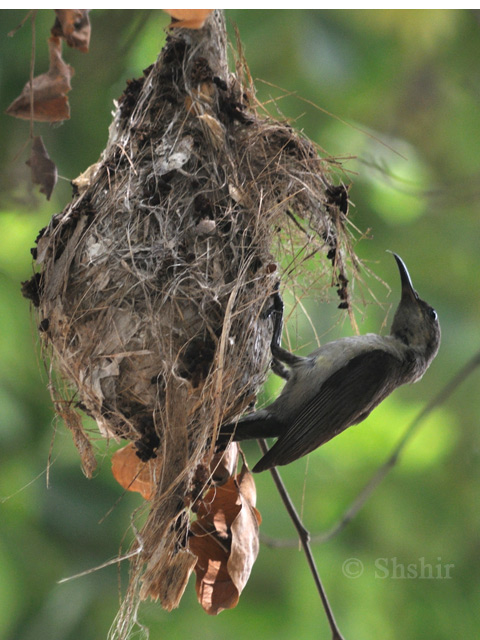
Sunbird, The Nest

Fig. The female Sunbird building the Nest
The nest of sunbirds are architectural marvel. It is generally suspended from a branch at a height of around 10ft from ground. It looks like an oval or oblong purse-shaped pouch with a hooded side-entrance.The collection of nest material and nest building are performed by the female alone with the male only accompanying the female.Before building the nest both male and female first select the appropriate branch of a tree.The female hover around it for a inspection and one can easily confused it with a humming bird. The nest materials consists of soft grasses, dry leaves, barks, pieces of paper and cobwebs.Cobwebs are generally used as a glue material. The nest is about 300 to 600 mm long from tail to tip.The diameter is around 50 to 70 mm at the broadest part.The outer layer consists of coarse materials like dried leaves, barks and even paper and polythene pieces.The inner layers consists of finer materials like cotton fibres or silky substances of seeds and flowers.The nest I observed mostly. The interior of the nest contains the egg chamber which is the thickest portion of the nest i.e 30mm thick.The interior gives utmost comfort to the chicks to grow.On a an average a nest is built with in 10 to 15 days.
Reblog this post [with Zemanta]

Wednesday, February 24, 2010

Purple-rumped Sunbird

Fig. This is the female and male purple-rumped sunbird

Purple-rumped Sunbird


Species Nectarinia zeylonica

Family Nectarinidae

Size About 10 cm

Purple-rumped Sunbird is a colorful and very active tiny little bird.This bird is endemic to Indian subcontinent and a common resident breeder in India, Sri Lanka and Bangladesh. Purple-rumped Sunbirds are smaller in size i.e less than 10 cm long.The male and female looks different.The males have a dark metallic maroon upper side with a blue-green crown which glitter on sunlight. Metallic violet patches are also found around throat and only visible at certain angle.The female has a white throat followed by yellowish breast.The upper side is olive or brownish. They have medium-length thin down-curved bills and tubular tongues which are made for nectar feeding. This photograph is taken at Debrigarh wildlife sanctuary , Sambalpur, India.
Reblog this post [with Zemanta]

Monday, January 25, 2010

Plani Prinia Feeding


The above photographs are showing the Plain Prinia parents feeding the chicks.I managed to locate the nest inside a bush at about 2 ft from ground.Observed it for almost 15 days. By the time the bird get comfortable with my presence. I waited and watched the bird feeding the chicks entire day.Finally got some feeding shots.You can clearly see the bird holding a grasshopper and feeding it to the chicks.The chicks are voracious feeders.They eat almost 3 to 5 times of their body weight.The parents keep the nest clean by clearing the droppings inside the nest.After 12 days of hatching finally the chicks left the nest.This is the beauty of nature and beauty of bird watching.Yhis photograph is taken with a 200 mm lens with Nikon F3 camera.
Reblog this post [with Zemanta]

Friday, December 4, 2009

Red-Vented Bulbul


Common name: Red-vented Bulbul
Species          : Pycnonotus cafer
Family            : Pycnonotidae
Size                : Smaller than a Myna


The Red-vented Bulbul  is a passerine bird  of the bulbul family .The body is a grayish  brown with a scaly pattern above and gray below.The Red-vented Bulbul is easily identified by its  crested glossy black head .  The rump is white while the vent is red i.e  a distinguishing  red patch under  the tail. The black tail is tipped with white. Both male and female look alike.This bird is commonly seen in gardens, scrub jungles and also near human habitation and cultivated lands.It feeds mainly on fruits, petals of flowers, nectar, insects etc. Mostly seen collecting figs to eat from the  trees like peepal and baniyan. The bird can be easily identified from its  whistling sound .It can be easily reared and tamed.In India it is used as a common fighting bird which shouldn't be.After all birds are born to be free.It is nice to observe them in their natural habitat moving freely.

Monday, November 9, 2009

Asian Paradise Fly catcher, The nesting


Nesting Season of Asian Paradise flycatcher is generally June to August i.e the rainy season.It may be due to availability of more flying insects during this period.

The nest is conical in shape and just the size of a tea cup.It is found hanging from a tip of a small and thin branch of a tree generally at a height of 8ft to 15ft from the ground. The nest is woven with fine grasses and fibers.The outer wall of nest is plastered with cob webs and spider egg shells. It is observed that the female alone built the nest.The female generally lays four numbers of pale pink colour eggs with blotches of reddish brown.In some cases three eggs are also found. Incubation takes nearly 18 days and both the parent incubate the eggs alternately.The nestling period is around 10 to 12 days.The chicks are raised by both the parents.

It is quite thrilling to watch the parents feeding the nestlings.I observed it very close to the nest.The photograph is taken by my pretty old Nikon 801 camera with a 200 mm lens.Watching nature so close is a rare experience to share.Enjoy the bird Watching.