Saturday, September 6, 2014
Nesting Behavior of Oriental Pratincole
Thursday, March 14, 2013
Oriental Pratincole
Scientific Name: Glareola maldivarum
The species is generally gregarious, occurring in small to large flocks.Oriental Pratincoles eat insects, including dragonflies, cicadas, beetles, moths, ants, termites, locusts, grasshoppers, flies, bees and wasps, they also eat flying insects.The species usually feeds aerially. The above photograph s taken at the Mahanadi Reservoir in Sambalpur, Odisha, India.
Saturday, January 5, 2013
Edible Nest
Monday, December 3, 2012
Floating Nest
is sitting for incubation, but due to water proof eggs the chicks easily come out without any harm.
Wednesday, October 31, 2012
Hole Nest in Trees
Wednesday, October 17, 2012
Hole Nest in Ground
Sunday, November 13, 2011
Mud Nest

Thursday, September 15, 2011
Black Naped Monarch Flycatcher Feeding
This is the video of a Black naped Monarch Flycatcher feeding it's chick.This Nest is located on a mango tree near Hirakud Reservoir.
Saturday, June 25, 2011
Hanging Nest


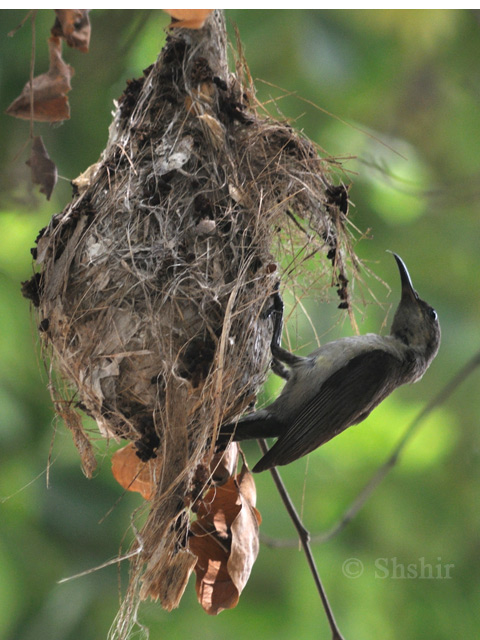
Among all nests build by birds , the hanging nests are the most complex nest bulding , an admirable of bird architecture. In indian the hanging nests found are that of Baya weaver and sunbirds. It require great skill by a bird to build such type of nest.The main purpose of such types of nests are protection from predators and adverse climate. These nests generally hung from the tip of a branch or leaf, or suspended between twigs. They are globular or retort-shaped with a single entrance hole. A completed baya nest looks like an upside down flask with a downward tube like pointing entrance .The swollen portion of the nest is the main nesting area or egg chamber.The sunbird nest is build with cobwebs and caterpillar excreta hanging from a tip of a branch or twig.
Tuesday, February 15, 2011
Cup nest with roof

The cup shaped nest with roof are more advanced than the usual cup nest.They are generally rounded or elliptical in shape and appears like a ball with a side entrance.This type of nest offer more protection to the eggs and chicks than a simple cup nest.These nests are built with grasses, leaves, fibers, small sticks etc.The inner is covered with soft materials to provide more comfort. Birds like Red munia, scally breasted munia, rufous bellied babbler, white munia, rufous winged bushlark etc build this types of nest. The photo above shows the nest of rufous bellied babbler.The nest is found in the vicinity of river Mahanadi in Sambalpur, Orissa, India.
Sunday, December 26, 2010
Cup Nest
Fig: Cup nest built by Asian Paradise FlycatcherThe cup shape nest is the 3rd inorder of simple to complex nest In my previous posts I have given information about first two type of nests.The cup shaped nest is more advanced than simple twig nest.This is the most typical form of nest and found in abundant as most flycatchers build this type of nest.The cup shape nest have a clear inside as well as an outside and the inside is lined with softer materials for more comfort.This type of nest also provide more protection for both the eggs and chicks.They are generally build at the forked branch of a tree i.e either "V" or "Y" shaped branch.These nests are build with leaves, grasses, finer twigs sticked together with cobwebs. Birds like Asian Paradise Flycatcher, Monarch Flycatcher, Faintail Flycatcher, Humming birds, Bulbul,Oriole, Drongo etc build cup shaped nest.
Wednesday, October 6, 2010
Nesting Behaviour of Birds: No Nest

The most simple form of nest is no nest at all.Many birds donot build any nest.They either lay eggs directly on the bare ground or rock surface. Some make simple scrap on the ground to lay eggs. It is observed that birds who leaves the nest soon after hatching, generally build this type of nest or more accurately they don't need complex nest at all.Nightjars lay their two eggs directly onto the ground.Birds like Plovers, Pratincoles, Lapwings, Little tern make simple scrap to lay eggs. As the eggs are on open surface they generally camoufladge with their surrounding and there by protected from predators. The picture above is a Little ringed Plover Nest with egg on open ground near a river bank.
Thursday, July 29, 2010
Nesting Behaviour of Birds
Nesting Behavior of Birds
There is a common misconception that Birds build nests to live in it. It is not true. The fact is that birds build nest to lay eggs, raise their chicks, protect them from predators and adverse climate. Birds are notable for their instinct to build nest like humans and other animals. The nest varies from no nest (e.g Pratincoles) to very complex nest ( Baya weaver).
The nesting behavior of birds, the shape and size of nest varies according to their habitat, climate, breeding season, size and physiology of bird and amount of threat by predators. Broadly the nests can be divided into 12 categories.
1. No nest/ scrap nest
2. Simple twig nest
3. Cup nest
4. Cup nest with roof
5. Ball nest
6. Hanging / very complex nest
7. Mud nest
8. Hole nest in ground
9. Hole nest in tree
10. Floating nest
11. Edible nest
In my upcoming posts I will deal details about the individual nests.Birds are notable for their ability to build their nests most skillfully.
Friday, May 7, 2010
Sunbird, The Nesting

Thursday, April 8, 2010
Purple Sunbird
Image via Wikipedia
Purple Sunbird
Species : Nectarinia asiatica
Family : Nectarinidae
Size : Smaller than sparrow
Monday, March 1, 2010
Sunbird, The Nest
Fig. The female Sunbird building the NestWednesday, February 24, 2010
Purple-rumped Sunbird
Fig. This is the female and male purple-rumped sunbirdPurple-rumped Sunbird
Species Nectarinia zeylonica
Family Nectarinidae
Size About 10 cm
Sunday, February 7, 2010
Sunbird

Sunbirds are colourful, attractive small passerine birds. and readily enter gardens where flowering plants are planted to attract them. The sunbirds and spiderhunters belongs to family Nectariniidae. The family is distributed throughout Africa, southern Asia and northern Australia.The sunbirds have two close relatives, the hummingbirds of the Americas and the honeyeaters of Australia. The resemblances are due to similar nectar-feeding lifestyle.There are more than 100 species of sunbird in 15 genera.Two most common species seen in India are Purple Sunbird (Nectarinia asiatica) and Purple-rumped Sunbird (Nectarinia zeylonica).When one sees them feeding nectar on flight can easily be confused it as Humming bird.However we have no Humming birds here in India.Sunbirds are frequent visitors to gardens where flowering plants are present.They also built their nest in backyard gardens .
Monday, January 25, 2010
Plani Prinia Feeding


Sunday, January 10, 2010
Small Minivet